A builder's post-sales workflow runs from booking to full collection: attach a payment plan template to the booking, raise dues the moment a construction milestone is certified, send demand letters in bulk by email and WhatsApp with a payment link, chase overdue lines with reminders and interest, and keep a buyer statement that always reconciles. A post-sales CRM for real estate is the system that makes those steps automatic enough for a small collections team to run a 300-unit project without a spreadsheet.
Key takeaways
- Payment plan templates (20:80, construction-linked, time-linked) should be set once per project and customer category, then inherited by every booking.
- A due line should exist only when a milestone is certified by the site team, not when sales promises it.
- Demand letters go out in bulk per milestone, each with the buyer's own amount, due date and a Pay Now link; online payments should record themselves.
- Reminders, late-payment interest and cheque-bounce charges need written rules before the first overdue, not after.
- The buyer statement (agreed, due, received, balance, interest) is the one document that ends most disputes.
What does a milestone-to-cash workflow look like for a builder?
Most collection problems are not caused by buyers who refuse to pay. They are caused by dues that were never raised on time, letters that went to an old email address, cheques nobody followed up, and statements that three people computed three different ways. The fix is a fixed sequence that every booking follows.
| Step | Trigger | Output | Owner |
|---|---|---|---|
| 1. Booking | Token received, unit held | Booking number, agreed price, payment plan attached | Sales |
| 2. Agreement | Agreement for sale registered | Agreement-stage line raised | Legal / collections |
| 3. Milestone certified | Site engineer confirms phase (plinth, slab, brickwork...) | Due lines raised for every booking on that plan | Site + collections |
| 4. Demand letter | Lines raised | Letter by email and WhatsApp with amount, due date, Pay Now link | Collections |
| 5. Payment | Online, cheque, NEFT, cash | Receipt, ledger entry, finance verification | Accounts |
| 6. Overdue handling | Due date passed | Reminder cadence, interest, agent alert | Collections |
| 7. Statement | Any time, and at registration | Buyer statement PDF | Accounts |
Everything below is a closer look at steps 1 to 7. The post-sales automation guide covers how this connects to what sales does before the booking.
How do you set up payment plan templates (20:80, CLP, time-linked)?
A payment plan template is a list of lines, each with a percentage (or fixed amount), a label and a due rule. Build the templates at project level before launch and let bookings inherit them.
Construction-linked plan (CLP)
Each line is tied to a construction phase: booking, agreement, plinth, specific slabs, brickwork, flooring, finishing, possession. The due date is unknown at booking because it depends on when the phase completes. This is the most common plan for under-construction towers because buyer cash follows visible progress, and home-loan disbursements can be matched to the same phases.
Time-linked plan
Lines fall due on fixed offsets from booking: 10% at booking, 10% at 30 days, 10% at 60 days and so on. Easy to administer and popular for plots and near-complete inventory, but it detaches payment from progress, and buyers push back when the site is behind schedule.
20:80 and other hybrids
A 20:80 or 10:80:10 plan is a hybrid: a fixed part at booking and agreement, the bulk on a later milestone or at possession. Model it as a template with two or three lines, one of them milestone-triggered.
Customer categories
Keep a separate template per category where terms differ: direct buyers, channel partner bookings, NRI buyers, bulk investors. Then a booking only needs the right category chosen and the schedule fills itself. The down payment is simply the first line of the template, so the token already collected is adjusted against it.
One regulatory point to keep in mind while designing plans: under RERA, a promoter cannot take more than 10% of the cost of the apartment or plot as advance or application fee without first entering into a registered agreement for sale, and a defined share of collections must go into the project's separate account. Procedures vary by state; read the Act and your state authority's rules via the Ministry of Housing and Urban Affairs before fixing the booking and agreement lines.
How do you raise dues when a construction phase completes?
The weakest link in most builders' collections is the handover between site and office. Sales says the slab is done; the site engineer says shuttering is still on; the letter goes out; buyers visit, see no slab, and stop trusting the next letter too.
Make the site team the trigger
The person who certifies a phase should be the project or site engineer, recorded with date and name. The certification should itself raise the due lines for every booking on that plan. If the CRM does it automatically, the collections team wakes up to a list of raised dues rather than a reminder to go and create them.
Set the due date rule once
A standard rule is due date = certification date + 15 days. Some builders use 7 or 21 days; what matters is that the rule is written into the plan, printed on the agreement and applied identically to every buyer, so nobody can argue they got less time than a neighbour.
Illustrative example
Tower A, 120 units, average agreed price ₹85 lakh, CLP with 10% per milestone. The 10th-slab phase is certified on 3 November. The system raises 120 lines of roughly ₹8.5 lakh each, about ₹10.2 crore in total, all due on 18 November. Of those, 70 buyers have home loans, so their lines are marked payable by bank and disbursement requests go to the respective lenders the same day. The remaining 50 get demand letters addressed to them personally. On 19 November, the overdue list is the only thing the collections team needs to open.
How should demand letters go out by email and WhatsApp?
A demand letter is a formal notice. It needs to be correct, traceable and easy to pay against.
What every letter must contain
- Buyer name, booking number, project, tower and unit
- Milestone label and certification date
- Agreed price, this instalment's amount, amounts received so far and balance after this line
- Due date and the late-payment terms from the agreement
- Bank details for NEFT/RTGS, cheque payee name, and an online payment link
- A contact person and the letter reference number
Use your own letterhead template with placeholders; the body should never be retyped per buyer.
Send in bulk, deliver individually
Letters are generated per line but sent in one batch per milestone: one action for all 50 buyers, each receiving their own PDF by email and the same letter as a WhatsApp message with a link. WhatsApp gets read within minutes; email provides the formal record. Send both. Changed phone numbers are the usual reason a letter "never arrived", so keeping contact details current is a collections task, not a sales afterthought.
Pay Now links and partial payments
A payment link tied to the specific due line, through a gateway such as Razorpay or Easebuzz, removes the "please share the UTR" loop: the payment records itself against the right line with the gateway reference. Allow partial payments on the same link, because a buyer paying ₹5 lakh of an ₹8.5 lakh line today is better than one who waits until the full amount is ready.
For the document side of agreements, letters and receipts, see why builders need a document management system.
How do you run overdue reminders, interest and cheque bounces?
Write the overdue policy before launch and apply it mechanically. Discretion creates disputes.
Reminder cadence
A reasonable cadence for an overdue instalment: reminder on day 1 after the due date, then every 7 days, by email and WhatsApp, each one restating the amount, interest accrued so far and the payment link. The buyer's assigned sales executive should be alerted on the same day the line goes overdue, because a call from the person who sold the flat works better than a third letter.
Late-payment interest
Keep it simple: simple interest, either a percentage per month or a fixed amount per day, applied after a grace period, and switched on only for projects where the agreement for sale allows it. The rate and grace period should be the same numbers printed in the agreement. Interest calculated by hand in Excel is a frequent source of disputes in buyer statements, so let the system compute it from the due date and the receipt date.
Cheque bounces
When a cheque bounces, the original receipt must be reversed, not deleted: mark it bounced, apply the bounce charge from your policy, and let the line return to due with interest continuing from the original date. The buyer should receive a fresh notice the same day. Keep the bounced instrument's details on file in case recovery proceedings are needed later.
Escalation to cancellation
Define when an overdue account moves from reminders to a cancellation notice, and who approves it. Cancellation should carry a configurable charge, a computed refundable amount and a refund record tracked until settled, with any channel partner commission on that booking voided. The channel partner management guide covers the commission side.
How do you record payments and give buyer statements?
Recording every mode
Online gateway payments record themselves. Cheque, NEFT/RTGS, UPI and cash entries are made by the collections executive with the reference number and then verified by finance (pending, then confirmed or rejected), with a separate clearance step for cheques. This two-step entry is what keeps a junior executive from closing a line on a promise.
Receipts
Issue a numbered PDF receipt per payment in your own format, showing the booking, the line it was applied to and the mode. For purchases of ₹50 lakh or more, the buyer deducts TDS under section 194-IA and deposits it through Form 26QB; your receipt and statement should show the gross instalment and the TDS credit separately. Details are on the Income Tax Department portal.
The buyer statement
The statement is the running account: agreed price, lines raised, due dates, amounts received by date and mode, balance, and interest. It should be printable at any moment and must match the ledger to the rupee. Most "you have charged me extra" conversations end when a clean statement is sent within an hour.
Home-loan tranches
For financed buyers, record the lender, loan account, sanctioned and disbursed amounts and each tranche with its UTR. Lines payable by bank should show as such on the statement, so the buyer is not chased for money the bank owes.
What should the collections dashboard show?
The owner's view is simple: for each project and date range, total sale value, received, pending and refunded, plus the overdue list sorted by days overdue and amount. Weekly review questions:
- Which milestones have been certified but still have unsent letters?
- Which lines are more than 30 days overdue, and who called those buyers last?
- How much of the pending amount is bank-payable versus buyer-payable?
- Which cheques are awaiting clearance?
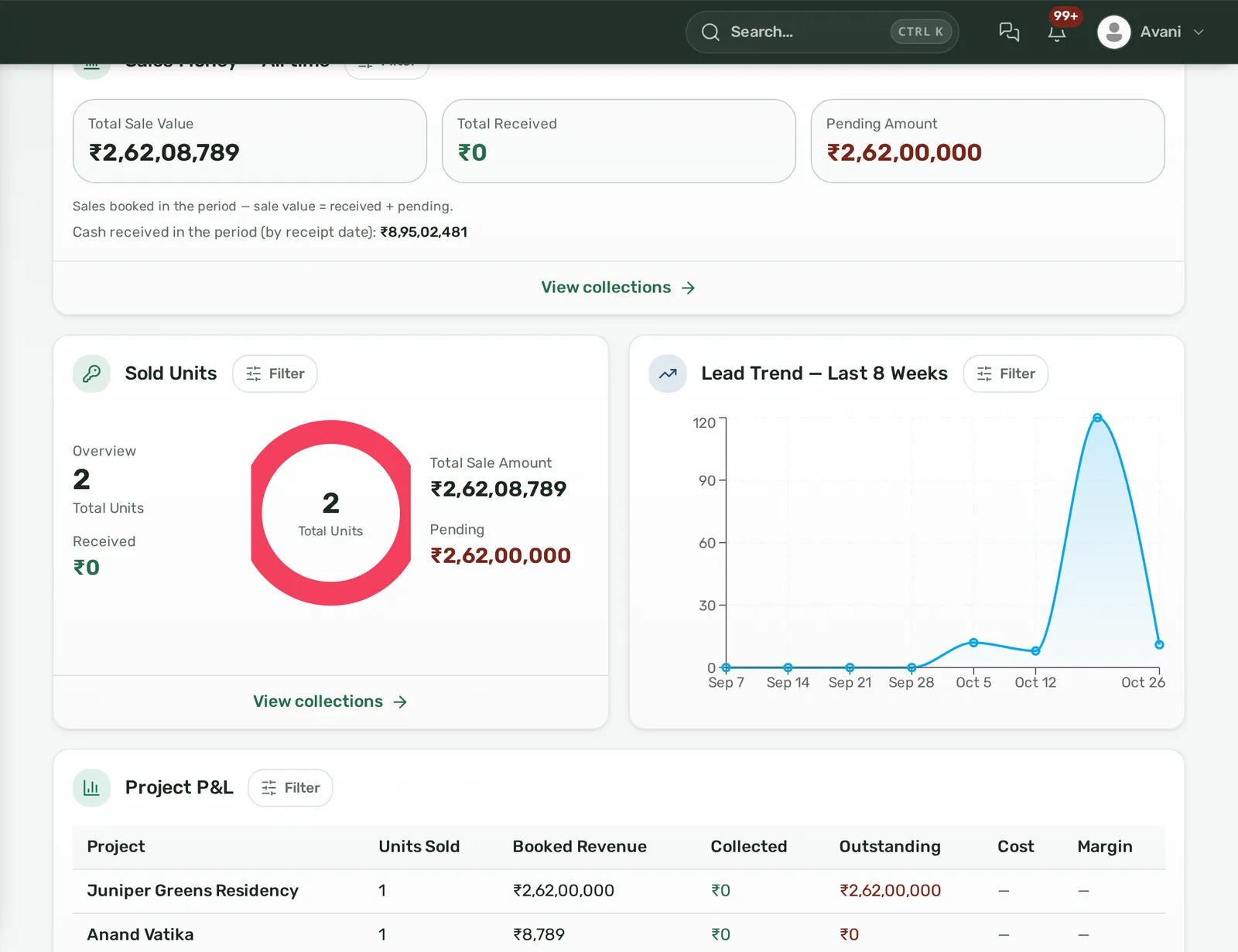
Pair this with the unit view so that a cancelled booking returns the unit to available stock immediately; the unit tracking guide explains that side.
Where does the collections workflow end?
The milestone-to-cash workflow finishes at full collection and registration: stamp duty paid, sale deed registered, zero balance on the statement. Handover activities that follow (possession scheduling, snag lists, society formation, customer helpdesk) are separate processes, usually run by a customer-care or facilities team with their own checklists and communication plan. Treat them as a second project rather than stretching the collections process to cover them. Knowing the difference between an allotment letter and a possession certificate helps set buyer expectations at the right stage.
How Homelead runs this workflow for builders
In Homelead's Builder panel, each project carries payment-term templates: percentage or fixed lines with due offsets, per customer category (a 20:80 plan is one template), with the down payment as the first line. Plans can be construction-linked, time-linked or hybrid, and a booking can carry a custom schedule where a deal was negotiated differently.
With CLP auto mode on, completing a construction phase raises the matching due lines on every booking on that plan with a due date 15 days out. Collections then opens "Recommended demands" and sends demand letters per line or in bulk by email and WhatsApp, each with a no-login link where the buyer sees that instalment, downloads the PDF and pays through the company's own Razorpay or Easebuzz account, including partial amounts, with the payment recorded automatically. Letters use the builder's own template with placeholders and a preview. Overdue lines can be set to auto-send and to remind every N days (default 7) by email and WhatsApp, and the lead's assigned agent gets an in-app, push and Telegram alert the day a line goes overdue.
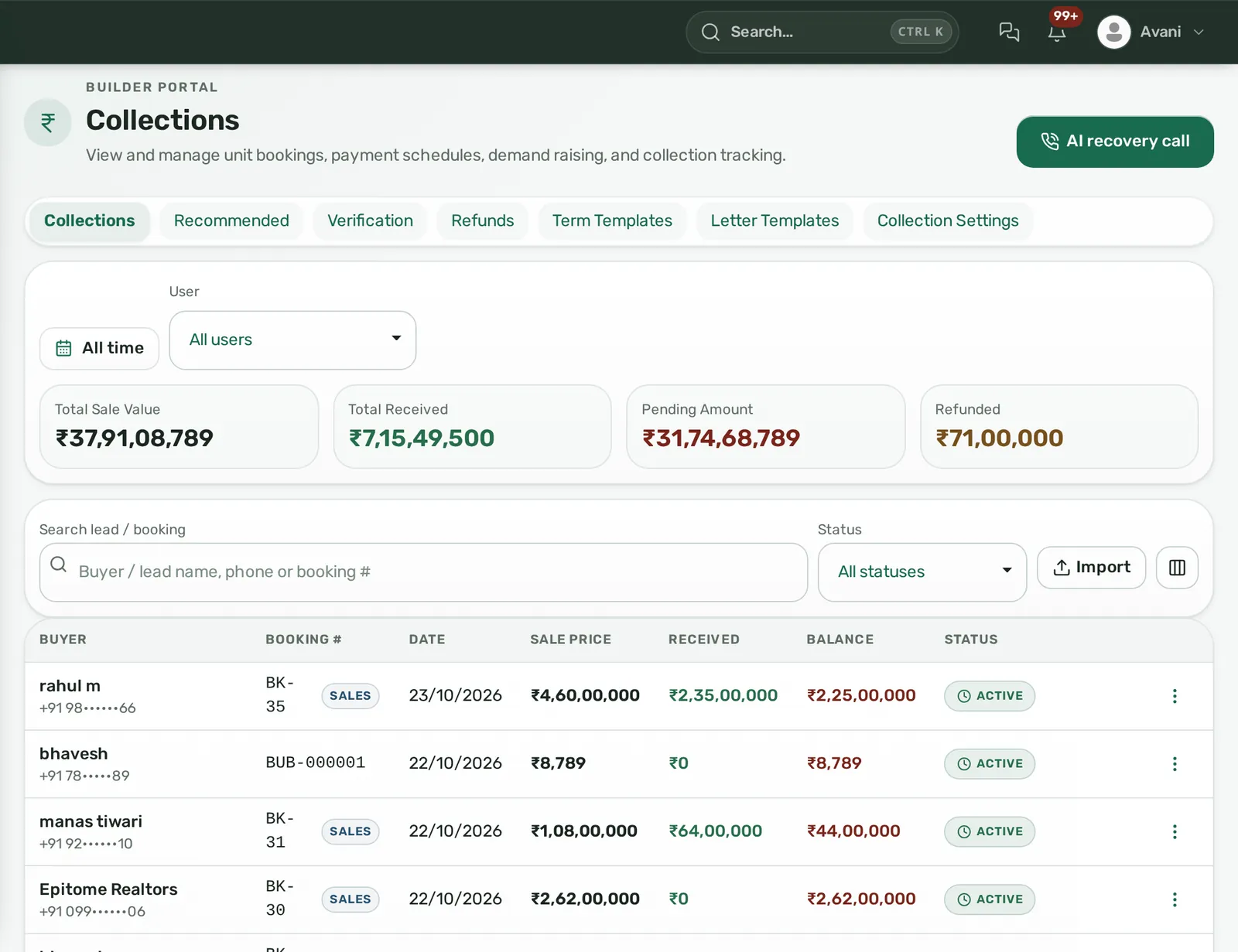
Late-payment interest is a Collection setting: simple interest, percentage or fixed, per day or per month after a grace period. A bounced cheque is marked on its receipt and the configured bounce charge is recorded. Offline payments (cash, cheque, UPI, NEFT, RTGS) are entered with a reference and pass finance verification and cheque clearance. Receipts are PDFs in the builder's own format; the buyer statement PDF shows agreed, due, received, balance and interest; the collections summary shows total, pending, received and refunded by project and date. Loans sit on the booking with sanction, disbursement and tranche UTRs. Cancellations apply a configurable charge, compute the refund, track it to settled and void due commissions. Every change lands in the Audit Logs with before and after values. See the platform overview for the rest of the Builder panel. To see it on your own project, send an inventory sheet and book a 20-minute demo.
Mistakes builders make with collections
- Raising dues from the sales calendar instead of certified site progress.
- Letting each executive write their own reminder messages, so interest and amounts differ between buyers.
- Deleting bounced receipts instead of reversing them.
- Chasing financed buyers for bank-payable lines.
- Keeping interest in a separate sheet that the statement does not read.
- Treating contact-detail updates as nobody's job.
- Having no written point at which an overdue account becomes a cancellation case.
Frequently asked questions
What is a construction-linked payment plan (CLP)?
A CLP ties each instalment to a construction phase such as plinth, specific slabs, brickwork or finishing. The amount per phase is fixed in the agreement; the due date is set when the builder certifies that phase complete, usually plus a notice period such as 15 days.
How much can a builder collect before the agreement for sale?
Under RERA, a promoter cannot accept more than 10% of the cost of the apartment or plot as advance or application fee without first entering into a registered agreement for sale. Check your state RERA rules for the exact procedure and the separate-account requirements on collections.
Should demand letters go by WhatsApp or email?
Both. WhatsApp gets read quickly and carries the payment link; email is the formal, archivable notice with the PDF attached. Keep contact details current, because a wrong number or stale email is the most common reason a buyer says they never received a letter.
How should late-payment interest be calculated?
Use the method written in the agreement for sale: typically simple interest at a stated rate per month or a fixed amount per day, after a grace period, from the due date to the date of receipt. Have the system compute it from the recorded dates rather than by hand.
What happens to commission when a booking is cancelled?
Any commission still due to a channel partner or executive on that booking should be voided when the booking is cancelled, and the refundable amount to the buyer computed after the agreed cancellation charge. Both should appear in the ledger so the figures reconcile.
Does a post-sales CRM cover possession and handover?
In the collections sense, a post-sales CRM runs from booking to full collection and registration. Possession scheduling, snag lists and society handover are usually run as a separate customer-care process with its own checklist and communication plan.