Hindi and Hinglish AI calling works for a real-estate team when three things are in place: a qualifying script written the way buyers actually speak, a voice tested on real phones and real networks, and strict rules about what the AI may change on a lead without a human looking. Get those right and the output is a speaker-wise transcript, a short summary and a disposition on every lead, in the language the conversation actually happened in. This guide walks through the setup with a sample script and a sample transcript you can adapt.
Key takeaways
- Write the script in spoken Hinglish, not English translated word by word; buyers reply in kind.
- Mid-sentence language switching is normal in Indian property calls, so test the voice and the transcript for it specifically.
- Decide in advance which lead fields the AI may update automatically and which stay with a human.
- Audio quality is decided by the handset, the recorder and the network before any AI touches it; test every phone model your team uses.
- Review AI transcripts weekly the way you review a new telecaller.
What does Hinglish AI calling mean for a real-estate sales team?
It means two connected things. First, an AI voice agent that dials outbound lists, speaks in Hindi or Hinglish, asks a fixed set of qualifying questions and hands a hot buyer to a human. Second, AI that listens to your telecallers' own recorded calls and writes the transcript, summary and next step onto the lead so nobody types notes after every call. The broader mechanics are covered in our guide to running an AI voice agent for real estate; this article is about making it work in the language your buyers use.
The three jobs worth automating first
- First-contact qualifying on portal and ad leads nobody has called yet: location, budget, configuration, timeline, purpose, site-visit willingness.
- Follow-up on stale leads: a short 'aap abhi bhi dekh rahe hain?' call to a list that has gone quiet for 30 days.
- Site-visit confirmation the evening before: confirm the time, share the location, note a cancellation.
Negotiation, price objections and anything after booking stay with humans. The AI's job is to find out who is worth a human's time and to record what was said.
Why English-first bots fail Indian buyers
A buyer in Pune or Lucknow who hears 'Could you share your preferred budget range?' often goes quiet, not because they lack English but because the register is wrong for a cold call. The same buyer answers 'Budget kis range mein soch rahe hain?' without thinking. Scripts translated from English also break the transcript: a model expecting one language mislabels the other as noise. Build in Hinglish from the start and both the call and the transcript improve.
How do you write a Hinglish qualifying script for property calls?
Keep it under two minutes of the buyer's time. The structure that works is: opener and permission, five or six questions with suggested answers, and a clear exit that says what happens next.
Script structure (illustrative)
| Step | Purpose | Hinglish line |
|---|---|---|
| Opener | Identify company and reason | Namaste, main Priya bol rahi hoon Sunrise Homes se. Aapne Sunrise Greens ke liye enquiry ki thi. |
| Permission | Lower resistance | Do minute baat kar sakte hain? |
| Location | Qualify area | Aap kaunsi location dekh rahe hain: Wakad, Hinjewadi, ya aas-paas? |
| Budget | Qualify range | Budget kis range mein soch rahe hain: 60 se 80 lakh, ya usse upar? |
| Configuration | Match inventory | 2 BHK dekh rahe hain ya 3 BHK? |
| Timeline | Urgency | Kab tak lene ka plan hai: agle teen mahine, chhe mahine, ya abhi sirf dekh rahe hain? |
| Purpose | Self-use vs investment | Khud rehne ke liye ya investment ke liye? |
| Site visit | Convert to action | Is weekend site visit ka slot book kar doon? Shanivaar ya Ravivaar? |
| Exit | Set expectation | Theek hai, main WhatsApp pe details bhej deti hoon, aur hamare executive Sunday se pehle call karenge. Dhanyavaad. |
Three details matter more than they look.
Offer ranges, not open questions. 'Budget kya hai?' gets 'dekhte hain'. 'Saath se assi lakh, ya usse upar?' gets a number. Suggested answers also make the transcript cleaner, because the buyer repeats words the model has already heard.
Use the numbers your buyers use. Lakh and crore in speech, never 'seven point five million'. If your project is quoted per square foot, write 'per square feet' the way site staff say it; a script that says 'per sq. ft.' is read out oddly by some voices.
Write the objection branches. The script needs an answer for 'abhi budget nahi hai', 'already book kar liya kahin aur', 'galat number', 'baad mein call karo' and 'kaun bol raha hai, yeh recording hai kya?'. Each branch should end the call politely and set a disposition. A script with no branches produces long, rambling calls and bad data.
Words to avoid
- Formal Hindi nobody speaks on the phone ('kripya apna anumanit budget batayein').
- Sales filler ('exclusive opportunity', 'limited period offer').
- Anything that pretends the caller is human. If asked, the agent should say it is an AI assistant from your company.
How do you choose a voice and handle code-switching?
Pick for clarity on a weak network
The best studio voice is not always the best phone voice. Phone audio is narrow-band; a slightly slower, lower-pitched voice with clear consonants survives a two-bar connection better than a fast, breathy one. Shortlist two or three voices, have three colleagues take test calls from a car and from an office, and ask which voice they had to strain to hear. Drop that one.
Test the hard words
Before going live, make the voice read the things it will say most: project names, locality names (Hinjewadi, Noida Extension, Thanisandra), tower and floor references, prices in lakh and crore, and phone-style numbers. Expect some locality names to be mispronounced on the first attempt. Respell those words phonetically in the script until each is right.
Let the buyer switch languages
Indian property calls switch mid-sentence: 'Haan, 2 BHK chahiye but possession ready hona chahiye.' Two things need to hold. The voice should reply in the mix the buyer used, not snap back to pure Hindi or pure English. And the transcript should keep each word in the language it was spoken, labelled by speaker, rather than translating everything into one. Test with a colleague who naturally code-switches and read the transcript line by line.
A related trap is dialect. 'Kitne ka hai' in Delhi and 'kitna padega' in Jaipur mean the same thing; the script should accept regional phrasing, and the team lead should listen to the first fifty calls in each new city.
What do transcripts and summaries look like after the call?
Once the recording is in, the AI produces three things on the lead: a speaker-wise transcript, a short summary with a disposition, and a suggested next step. Here is what a good set looks like for the script above. This is illustrative, not a real call.
Speaker-wise transcript
Agent: Namaste, main Priya bol rahi hoon Sunrise Homes se. Aapne Sunrise Greens ke liye enquiry ki thi, do minute baat kar sakte hain?
Customer: Haan bolo, dekh raha tha Wakad side mein.
Agent: Budget kis range mein soch rahe hain, 60 se 80 lakh ya usse upar?
Customer: Around 75 lakh. 2 BHK chahiye, possession ready ho toh better.
Agent: Sunrise Greens mein 2 BHK ready-to-move units hain, 72 se 78 lakh ke beech. Is weekend site visit ka slot book kar doon?
Customer: Sunday subah 11 baje theek rahega.
Summary and disposition
Summary: Interested buyer, Wakad area, budget around ₹75 lakh, wants a ready-to-move 2 BHK for self-use. Agreed to a site visit on Sunday at 11:00.
Disposition: Interested, site visit requested. Temperature: Hot.
Next step: Confirm the visit on WhatsApp with the location link; assign to the Wakad site executive.
What a team lead should check
- Summary against transcript. Read five random pairs a day for the first month.
- Numbers. '75 lakh' heard as '70 lakh' or '7.5 crore' is the most common and most expensive error.
- Staying in script. When the buyer asked something the agent did not know, the right behaviour is 'main executive se confirm karwa deti hoon', not an invented answer.
- Stopping when told. A buyer who said 'abhi nahi' twice should not have been asked a third question.
The summary is only useful if the next person to touch the lead sees it next to the WhatsApp thread and earlier notes; that is the whole point of a lead follow-up system rather than a folder of recordings.
What guardrails should control automatic lead updates?
The point of transcription is to update the CRM without typing. The danger is that a bad transcript or a wrong-number call silently moves a lead to the wrong stage. Set explicit rules and insist your CRM enforces them:
- The call was answered. Missed and unanswered calls change nothing.
- Minimum duration and minimum words. A five-second 'galat number' is not a conversation.
- A positive signal is required. Stage or status move only when the buyer showed interest or asked for a callback, and never when they said they are not interested.
- Forward only. Automatic updates may move a lead ahead; they may never pull a lead out of Won or Lost.
- Humans win. If a telecaller edited the lead after the call started, the AI update must not overwrite it.
- New leads only on intent. A call from an unknown number creates a lead only if the person asked about a property.
Write these down as team policy, and treat 'the AI moved my lead' as a bug report, not a shrug.
How do you check audio quality across different handsets?
Everything downstream depends on what reached the recorder. Phone makers record calls differently: some capture both sides cleanly, some capture the near side louder than the far side, and calls on earbuds or speakerphone sound different again. Run this check for every phone model on the team before you trust the transcripts:
- Make one two-minute test call per handset model, in Hinglish, with a price and a locality name in it.
- Listen: are both speakers audible at similar volume? Is there echo on speakerphone?
- Read the transcript: are both speakers labelled correctly, and are the numbers right?
- Repeat with Bluetooth earbuds if the team uses them.
- Record the result in a sheet: model, recorder used, both sides captured, transcript rating 1 to 5.
- Standardise. If two models score poorly, it is cheaper to move those users to a known-good handset than to argue with their transcripts every day.
Also set the basics: earpiece or wired headset in noisy offices, battery-saver modes that kill background uploads switched off, and stable office Wi-Fi so recordings upload promptly.
What are the compliance basics for AI calls in India?
Put these in place from day one and take your own legal advice on specifics:
- DND scrubbing. Do not place promotional calls to numbers on the national Do Not Disturb registry. TRAI's regulations on commercial communication are the reference; check TRAI for the current rules.
- Calling window. Daytime only; 9 am to 9 pm is the conservative window most teams use.
- Disclosure. Tell the person the call is recorded and, if asked, that they are speaking to an AI assistant.
- Purpose. Call about the enquiry they made or the project they asked about, not a generic pitch.
- Opt-out. If someone says do not call again, add them to your suppression list the same day.
Keep recordings and transcripts inside the CRM with role-based access, not forwarded around WhatsApp groups; see how tenant isolation and permissions should work.
How does Homelead run Hindi and Hinglish AI calls?
Homelead's AI voice agent speaks English, Hindi and Hinglish. You define its persona and script in the AI Center, including the qualifying questions (budget, location, BHK or property type, timeline, purpose, site-visit willingness), and it answers project questions from your Knowledge Center: the brochures, price sheets and live inventory you have uploaded. When a buyer is hot, the agent warm-transfers the call to a colleague's phone mid-conversation, and every handoff is logged on the lead.
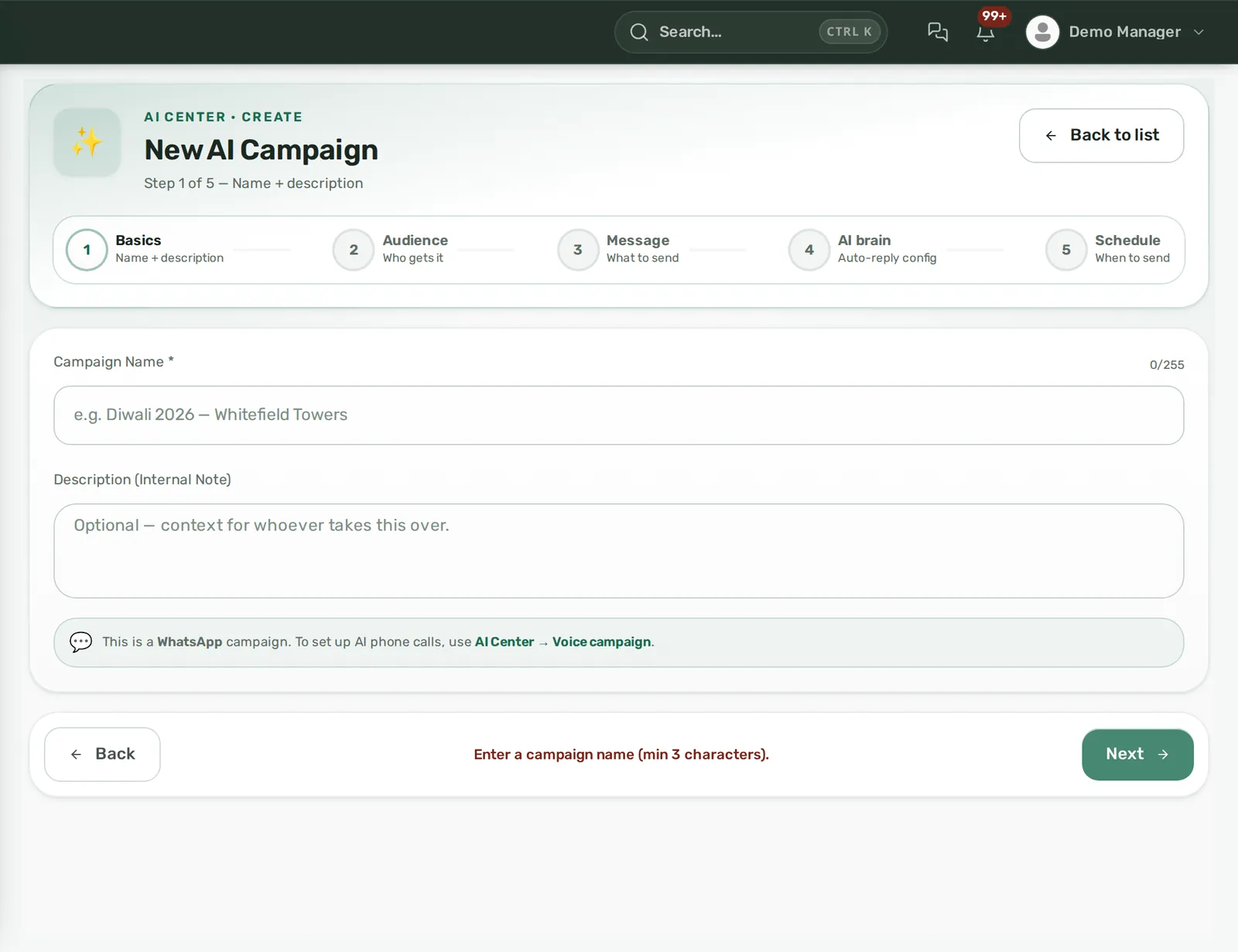
Business calling numbers are bought inside AI Center → Phone Numbers (KYC, choose number and lines, pay from the usage wallet). There are eight natural neural voices, four female and four male, each able to speak more than one language, so a buyer who switches between Hindi and English gets a reply in kind. The agent speaks a recording disclosure by default and, if asked, says honestly that it is an AI assistant. Guardrails are built in: a DND list, a 09:00 to 21:00 IST calling window, and a wallet check before every call.
For your own telecallers, the Homelead app syncs call logs and uploads recordings from their phones; the AI then writes a speaker-wise transcript in Hindi, English or mixed Hinglish, plus a summary, disposition and next step on the lead, usually within minutes. Automatic lead updates follow a fixed rule: the call must be answered, at least 10 seconds long, with more than 15 words transcribed, and the buyer must have shown interest or asked for a callback without saying they are not interested. Updates move stage, status and follow-up forward only, never out of Won or Lost, and never overwrite a change a human made after the call started. An interested call from an unknown number can create a new lead on its own. Recordings and transcripts are visible by role scope: agents see their own calls, managers their team's, admins everything. AI voice minutes and transcription are metered per minute from the usage wallet, with rates shown on the Wallet screen and no flat AI fee. See pricing for plans, or book a demo and bring a lead list to hear the agent call in Hinglish.
Frequently asked questions
Can an AI agent handle a buyer who switches between Hindi and English mid-sentence?
Yes, provided the voice is multilingual and the script was written in Hinglish rather than translated from English. Test it with a colleague who code-switches naturally and read the transcript before going live.
Should the AI say it is an AI?
Yes. Honest disclosure when asked keeps trust and keeps you on the right side of consent. Most buyers do not mind as long as the call is short and about the enquiry they made.
What should the AI never change on a lead automatically?
It should never move a lead out of Won or Lost, overwrite a human's edit, or change status on an unanswered or 'not interested' call. Forward-only updates on a positive signal are the safe default.
How accurate are Hinglish call transcripts?
Accuracy depends on audio quality: handset, earpiece or speaker, network and background noise. Numbers and locality names are the usual failure points, so check those first in your test calls on each phone model.
Does AI calling replace telecallers?
No. It replaces the first qualifying call and the note typing. Negotiation, objection handling and site visits stay with humans, who now spend their time on buyers the AI found worth it.
What does Hinglish AI calling cost?
In Homelead, AI voice minutes and call transcription are charged per use from a wallet, with no flat AI fee; the exact rates are on the Wallet screen. The wider cost model is explained in our guide to real-estate CRM pricing per user.