A real estate CRM for developers in the UAE has to do four things a brokerage CRM never needs to: hold a live unit inventory across towers and plots, run an external broker network with its own commissions, carry every booking through a payment plan to collection, and tie all of that back to the lead that started it. The right choice is the system where the unit, the buyer, the broker and the instalment schedule sit on one record, so your sales head sees a single pipeline from first enquiry to the last cheque clearing.
Key takeaways
- Developer sales are inventory-led and broker-led; brokerage sales are listing-led and agent-led. The CRM must model units with one status each, not just listings.
- A developer pipeline has two halves: lead-to-booking and booking-to-collection. Buy a system that covers both, or you will spend years reconciling a CRM against a finance spreadsheet.
- Broker management is a pipeline feature, not an afterthought: shared inventory, booking requests, lead-ownership rules and commission legs.
- Check AED invoicing, English/Arabic, cheque handling, permissions and audit logs before you judge the AI features.
How is developer sales different from brokerage sales in the UAE?
The habit of calling everything a 'real estate CRM' hides a real difference. A Dubai brokerage sells other people's property and earns a commission at transfer. A developer sells its own fixed stock and collects money over months or years. The pipeline looks the same for the first three stages and then diverges completely.
You sell inventory, not listings
A brokerage can list a unit on several portals and never worry about selling it twice, because the owner decides. A developer has exactly one unit 1204 in Tower A. On launch weekend two in-house agents and five external brokers may each have a buyer for it. The CRM has to hold one status per unit, show that status to everyone who can sell it, and refuse a second booking. A spreadsheet shared on WhatsApp cannot do that.
Brokers are a sales channel you have to manage
Many UAE developers close a significant share of their units through registered brokers. That means onboarding brokers, giving them inventory and price lists, accepting their booking requests, deciding who owns a lead when two brokers introduce the same buyer, and paying commission on an agreed schedule. In a brokerage CRM, the broker is the user. In a developer CRM, the broker is a partner record with commission terms, project allocation and visibility limits.
Money arrives over a schedule, not at one closing
A brokerage earns once. A developer books a unit with a deposit and then collects instalments by construction milestone or calendar date, often by post-dated cheque. Every instalment needs a due date, a demand letter, a reminder, a receipt and a record of whether the cheque cleared. A CRM that stops at 'Won' is only half of what you need.
Several projects, several launches, several price lists
A developer usually runs projects at different stages at once: one in pre-launch, one selling, one in handover. Price lists change, launch days create spikes, and the same sales team covers all of it. Reporting has to work per project as well as per agent.
| Area | Brokerage CRM | Developer CRM |
|---|---|---|
| Core record | Listing + lead | Unit + lead + booking |
| Who sells | Your agents | Your agents + external brokers |
| Availability | Owner's decision | One status per unit, hold and release rules |
| Revenue event | Commission at transfer | Deposit, then scheduled instalments |
| Partner payouts | Rare | Broker commission per deal, often milestone-based |
| Reporting | By agent, by source | By project, tower, agent, broker and collection status |
What does a developer's sales pipeline look like from enquiry to collection?
Think of the pipeline as two linked halves. The sales team owns the first; the collections or finance team owns the second; the lead record connects them.
| Stage | Owner | Exit criterion |
|---|---|---|
| 1. Enquiry captured | System | Lead has source, sub-source, project interest and an assigned user |
| 2. Qualified | Agent | Budget, unit type, purpose (end-use or investment), timeline and residency status for KYC confirmed |
| 3. Presentation or site visit | Agent | Visit or video presentation completed, feedback logged |
| 4. Unit shortlist and hold | Agent + sales admin | Specific unit on hold with an expiry time |
| 5. Booking | Agent + finance | Deposit received, payment plan attached, broker (if any) linked |
| 6. Payment plan active | Collections | Schedule generated, first demand letter sent |
| 7. Collections | Collections | Each instalment received, cleared and receipted; overdue lines chased |
| 8. Handover preparation | Post-sales | Balance cleared, registration formalities done |
Registration and title formalities follow Dubai Land Department rules and are documented on the DLD website; this article focuses on the sales and collections mechanics around them.
Illustrative example: a developer with three projects and a 12-person in-house team receives roughly 900 enquiries in a launch month. Around a third arrive through brokers, a third from portal and Meta ads, and the rest from the website, walk-ins and referrals. By stage 4 the funnel narrows to a few hundred held units; by stage 5 to perhaps 60 bookings. Those 60 bookings then generate something like 500 to 700 instalment lines over the plan term. The first half of the pipeline is about speed and attribution; the second half is about not losing a single line. (These numbers are invented to show the shape, not a benchmark.)
How should a developer CRM capture and route leads from many sources?
Capture every source with a sub-source
Developers receive leads from Property Finder, Bayut and dubizzle, Meta (Facebook and Instagram) lead ads and click-to-WhatsApp ads, Google campaigns, the project website, broker submissions, sales-centre walk-ins, exhibitions and roadshows. Each lead needs a locked source and a sub-source: the ad set, the portal listing, the broker name, the event. Without that you cannot answer the question every marketing manager is asked after a launch: which spend produced bookings, not just enquiries. The practical setup is covered in Bayut, Property Finder and dubizzle lead capture.
Route in-house leads and broker leads differently
An in-house lead should be auto-assigned by round robin, capacity or language within minutes, with a first-response SLA that escalates to the team lead if nobody calls. A broker-introduced lead should be registered against that broker with a timestamp, assigned to a developer-side relationship manager, and protected for an agreed window so a second broker cannot claim it. Write the rule down before the first launch, not after the first dispute.
Respect how UAE buyers communicate
Buyers here, resident or overseas, usually reach for WhatsApp before they pick up the phone, and overseas investors may be several time zones away. Your CRM needs a shared WhatsApp inbox tied to the lead, approved templates for messages outside the 24-hour window, and a way for an AI assistant or a night-shift agent to answer project questions when the sales team is asleep. Response time is a stage-1 metric: track it per source, per agent and per hour of day.
How do you manage a broker network inside the pipeline?
A developer CRM should treat the broker like a channel partner with its own master record and its own view into your stock.
- Broker master: company name, licence and agent registration details, agreed commission (percentage of deal or fixed), the projects they may sell, and the developer-side owner who manages the relationship.
- Shared inventory: brokers request access to a project, you approve, and they see live status. This one feature removes most of the 'but your broker told me it was available' calls.
- Booking requests: a broker submits a booking for a unit and buyer; your sales admin accepts, rejects or asks for documents; an accepted request becomes a sale that both sides can see.
- Lead ownership: first registration with a timestamp wins, for a defined period, with a clear escalation path.
- Commission: calculated per deal, split into legs where applicable, payable only after agreed collection milestones, and voided automatically if the booking is cancelled.
The broker side deserves its own operating manual; channel partner management from onboarding to payouts goes deeper on commission structures and partner reporting.
What must live unit inventory do for a developer?
Inventory is the record of truth for the whole pipeline, so judge it strictly.
- Hierarchy: project, tower, floor, unit, plus plots for land projects, each with its own price, type, view and size attributes.
- One status per unit: Available, Hold, Temporary Booked, Booked, Allotted, Sold (and On Rent if you keep a leasing arm). Status should change automatically on booking and cancellation, not by someone editing a cell.
- Hold rules: who can hold, for how long, and what happens on expiry, with a history of every hold and release.
- Double-booking block: a booking attempt on a sold or allotted unit must be refused by the system.
- Filters and exports: by project, tower, floor, status, type and price band, so sales admin can produce a broker price list in minutes.
- Visual maps: a clickable tower or plot map with live colours saves the sales-centre team from reading tables on launch day.
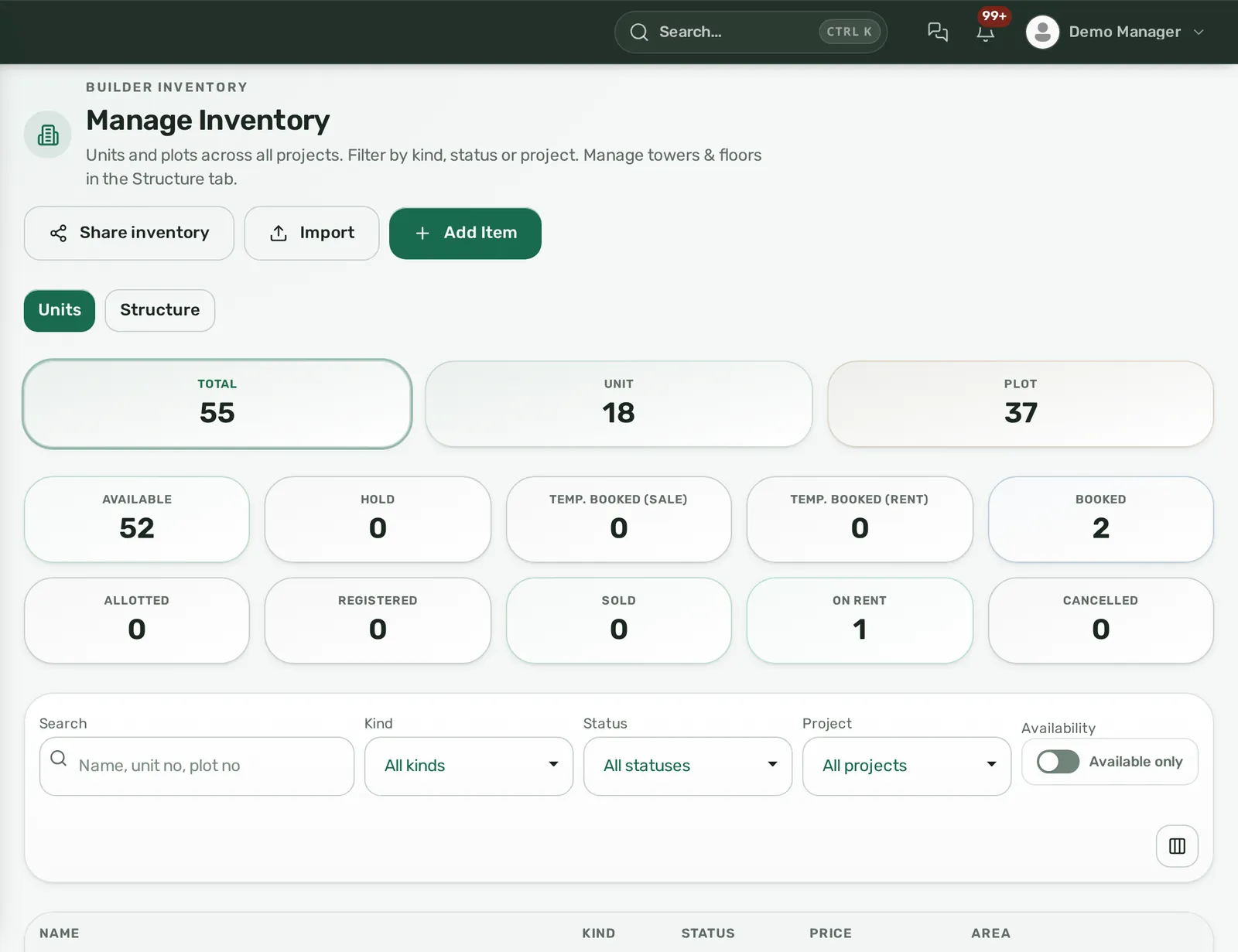
For the mechanics of statuses and audit trails, see how a unit tracking system works.
How do payment plans and collections fit into the pipeline?
Collections is where developer CRMs most often fail, because many were built for brokerages and had a payments tab bolted on later. Check for the following, in this order.
Plan templates and per-booking schedules
You should be able to define templates (for example 20:80, 60:40, a milestone-linked plan with named construction phases, or a time-linked monthly plan), apply one at booking, and adjust lines for a specific buyer without breaking the template. The deposit should be the first line of the plan, not a separate record.
Demand letters, reminders and the buyer's view
Each due line needs a demand letter in your own format, sent by email and WhatsApp with a link the buyer can open without logging in. Overdue lines should trigger reminders on a schedule you control and alert the agent who owns the relationship. A buyer statement (agreed, due, received, balance) should be one click away.
Cheques, transfers and verification
Post-dated cheques are still common in UAE developer sales. The system must record a cheque with its date and reference, move it through a clearance step, mark it bounced with a configurable charge, and keep a finance verification step between 'agent says received' and 'confirmed'. Cash and bank-transfer entries need the same reference discipline.
Receipts, statements and tax invoices
You need receipts in your own PDF format for every collection, project-wise summaries of received, pending and refunded, and tax invoices that meet Federal Tax Authority requirements. The FTA publishes what a valid tax invoice must contain; your CRM should produce one in English and Arabic from the booking data rather than from a separate template someone maintains by hand.
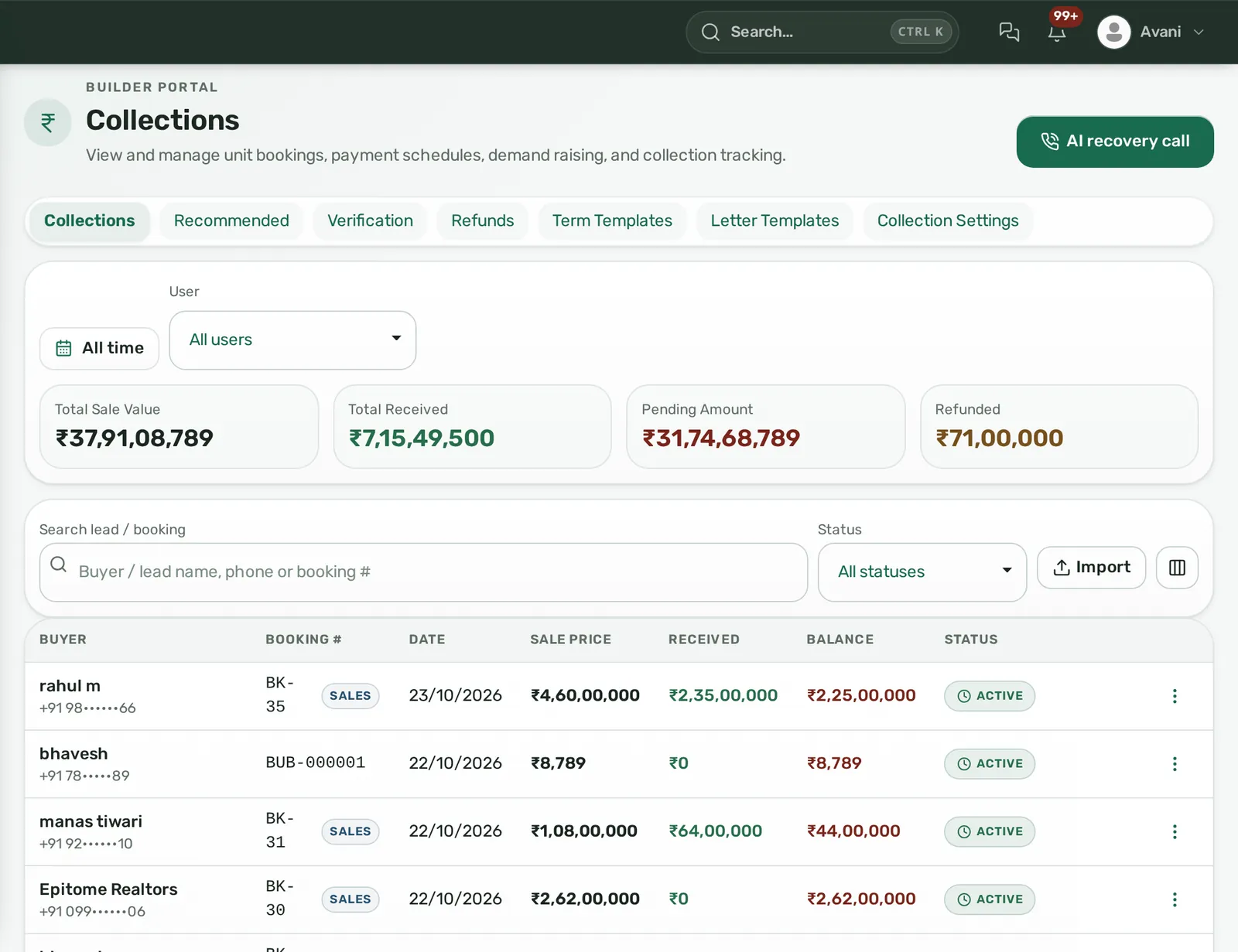
Off-plan escrow and project account obligations are a matter for your finance and legal teams. Keep the CRM as the operational record of what was demanded, received and cleared, and reconcile it with the bank, not the other way round.
What should UAE developers check when choosing a CRM?
Use this as the agenda for every demo. Ask the vendor to show each line on your own inventory sheet, not on sample data.
| Area | What to check |
|---|---|
| Lead capture | Portal, Meta and website sources with sub-source; partner API or form for broker-submitted leads; duplicate detection that flags rather than drops |
| Routing | Auto-assign by source and capacity; first-response SLA with escalation; broker lead-protection rule |
| Pipeline | Tenant-defined stages; site visit booking with confirmation; quotation or cost sheet from the live unit price |
| Inventory | Tower/floor/unit and plot hierarchy; one status per unit; hold expiry and history; double booking refused |
| Brokers | Partner master with commission and project allocation; shared inventory; booking requests; commission legs; voided on cancellation |
| Collections | Plan templates; demand letters in own format; reminders; cheque clearance and bounce; finance verification; receipts; buyer statement |
| UAE specifics | AED invoicing; English and Arabic interface; bilingual tax invoice; agent registration fields; AML/KYC checklist on each deal |
| Governance | My/Team/All scopes by reporting line; granular permissions; 2FA; audit log with before/after on bookings and payments |
| Reporting | By project, tower, agent, broker and source; collections summary; funnel; exports to Excel |
| Cost | Per-user price and seat minimum; what sits in a usage wallet; WhatsApp and messaging charges; add-ons |
The longer version of this list is in the 25-feature checklist for builder CRMs, and the cost questions are unpacked in real estate CRM pricing per user.
How does Homelead fit a UAE developer's pipeline?
Homelead is built for exactly this split between sales and collections, with a Builder panel for developers and a broker side that connects to it. The UAE setup is described on the markets page.
- Leads: every lead carries a lockable source and sub-source. Meta Lead Ads connect from inside the panel, website and microsite forms create leads directly, a generic webhook with field mapping takes any other feed, and a partner API key lets a call centre or broker tool post leads straight in. A first-response SLA (default 60 minutes) warns before the deadline and can notify the assignee, escalate to the manager, flag the lead or reassign it. Needs Attention ranks open leads with a next best action for each.
- Inventory: towers, floors and units, plus plots, each with a status (Available, Hold, Temporary Booked, Booked, Allotted, Sold). A booking on a Sold or Allotted unit is refused, and every hold and release keeps a history. AutoCAD plot files and tower maps become clickable live-status maps.
- Brokers: a Channel Partners master with commission percentage and project allocation. Shared Inventory lets a broker request access to your stock, you approve, and they see live status. Brokers submit booking requests from their own My Bookings screen; once you accept one, it becomes a sale visible on both sides. Commission is tracked in owner, buyer and reference legs, and a cancelled booking voids due commission.
- Collections: payment-term templates (percentage or fixed lines with due offsets, such as 20:80), construction-linked, time-linked or hybrid plans, and a custom schedule per booking. Demand letters go per line or in bulk by email and WhatsApp with a shareable no-login link; overdue reminders run on a schedule you set. Cash, cheque and transfer entries carry a reference, with an optional finance verification step, cheque clearance and a configurable bounce charge. PDF receipts in your own format, buyer statements (agreed, due, received, balance) and a collections summary of received, pending and refunded amounts by project and date.
- UAE specifics: AED invoicing, an English and Arabic panel, a bilingual FTA tax invoice view, Property Finder listing push and a Bayut/dubizzle listing feed, agent RERA number and card expiry fields, and a deal-file compliance checklist covering AML/KYC. The WhatsApp AI bot answers project questions from your own Knowledge Center in the buyer's language.
- Governance: My/Team/All scopes by reporting line, 120+ permission rows, 2FA, and audit logs with before/after values on leads, bookings, commission payments and settings.
Pricing is per user per month in USD, from $24.99 on Growth down to $16.99 on Enterprise depending on seat count, invoiced in AED for UAE customers; Enterprise adds multi-branch, SSO/SAML and custom modules and APIs. Book a demo and send your inventory sheet first so the walkthrough runs on your own projects.
What mistakes do developers make when rolling out a pipeline CRM?
- Buying a brokerage CRM and keeping units in Excel. The CRM says 'Won', the spreadsheet says 'Booked', and nobody knows which is right on Monday morning.
- Letting brokers send leads on WhatsApp. Ownership disputes become unresolvable without a timestamped registration form or API.
- No hold expiry. Units sit on indefinite hold for a buyer who went quiet, while real buyers are told the tower is sold out.
- A finance tool with no link to bookings. Every demand letter is typed by hand and the agent never hears that an instalment is overdue.
- Permissions set too wide. A departing agent exports the buyer database. Scope visibility by reporting line and keep exports permission-gated from day one.
- Measuring enquiries instead of bookings per source. Marketing optimises for cheap leads and sales gets the wrong buyers.
Frequently asked questions
What is the difference between a real estate CRM for developers and one for brokerages?
A brokerage CRM centres on listings and agent follow-up. A developer CRM adds a live unit inventory with one status per unit, an external broker network with commissions, and a payment plan and collections module so every booking is tracked until the last instalment clears.
Can a developer run collections inside the CRM instead of a separate finance system?
Yes, if the CRM has plan templates, demand letters, reminders, cheque clearance, finance verification and receipts linked to the booking. Keep your accounting system as the book of record and reconcile; the CRM is the operational collections record that the sales team and buyers interact with.
How should brokers see developer inventory?
Through a shared view of live unit status that you grant per project, with booking requests submitted through the system rather than by message. That way a broker never sells a unit that was booked an hour earlier.
What UAE-specific features should a developer CRM have?
AED invoicing, an English and Arabic interface, a bilingual tax invoice view, fields for agent registration numbers and card expiry, an AML/KYC checklist on each deal, and messaging that works through official WhatsApp templates for buyers who prefer chat to calls.
How much does a real estate CRM for developers in the UAE cost?
Most are priced per user per month with a minimum seat count, plus usage charges for WhatsApp, SMS, email and AI features. Homelead, for example, lists $24.99 to $16.99 per user per month depending on plan and seats, invoiced in AED for UAE customers, with a pay-per-use wallet for messaging and AI.
Do we need the CRM to handle off-plan registration steps?
The CRM should record them as time-stamped stages on the deal with a checklist, but the formalities themselves follow Dubai Land Department procedures. Treat the CRM as the tracker, not the authority.