An off-plan sales CRM for Dubai has to carry a deal well past the lead stage: expression of interest, launch-day allocation, unit hold, booking, payment plan, demand letters, DLD registration (Oqood) and finally the title deed, with AML/KYC documents attached to each booking. The practical test when choosing one is whether a single system holds the unit, the buyer, the money and the DLD stage together, so no unit is sold twice and no instalment is chased from a spreadsheet.
Key takeaways
- Off-plan is an inventory and collections problem first and a lead problem second. Evaluate a CRM on units and payment plans before you evaluate it on lead capture.
- Launch day succeeds or fails on hold rules: who can hold, for how long, and what happens when a hold expires.
- Payment-plan templates (20/80, 60/40, construction-linked) should generate demand letters and reminders without a parallel Excel tracker.
- Oqood, DLD fees and the title deed belong in a dated, owned stage tracker on each booking, not in a notes field.
- Keep an AML/KYC checklist on every booking and confirm current fees and forms with the Dubai Land Department.
- Brokers need live stock and a booking-request flow; developers need partner commission that is voided automatically when a booking is cancelled.
What does an off-plan sale in Dubai look like, stage by stage?
Every off-plan deal moves through the same sequence, whether you are a developer selling direct or a brokerage working the launch. The CRM has to record something specific at each step.
| Stage | What happens | What the CRM must record |
|---|---|---|
| Pre-launch EOI | Buyer registers interest, often with a refundable EOI deposit | Lead with source and sub-source, unit-type preference, budget, EOI amount and receipt, agent or partner reference |
| Launch allocation | Units are released and buyers choose; holds are placed in priority order | Unit status Hold with timestamp, holder and expiry; hold and release history |
| Booking | Booking form signed, booking deposit paid | Booking with unit, agreed price, deposit receipt, buyer KYC |
| SPA and payment plan | Sales and purchase agreement signed; instalment schedule agreed | Payment-plan lines with due dates or construction milestones |
| Oqood registration | Sale registered with DLD in the buyer's name; registration fee paid | Stage date, who completed it, registration reference, fee record |
| Construction instalments | Demand letters per milestone; collections into project escrow | Due lines, letters sent, receipts, overdue status, any contractual interest |
| Handover and title deed | Completion, final payment, title deed issued | Stage dates, zero balance, handover documents |
Everything in that table sits on three objects: the lead (who), the unit (what) and the booking (money and stages). CRMs that struggle with off-plan are the ones built around the lead alone, with units and payments bolted on as custom fields.
Off-plan sales in Dubai are regulated by RERA under the Dubai Land Department, which covers project escrow accounts, interim registration (Oqood), broker registration and the standard forms. Rules and fees change, so treat the figures in this guide as the usual defaults and confirm the current position on the Dubai Land Department website.
How should a CRM handle EOIs and launch-day allocation?
Treat an EOI as a lead with money attached, not a booking
An expression of interest is a qualified lead that has paid a refundable amount to get a place in the queue. The clean way to model it: a lead stage called EOI received, a payment record for the deposit with its receipt, and fields for preferred unit type, budget band, and the agent or channel partner who registered the buyer. The EOI timestamp and the deposit date become the priority order on launch day.
The common mistake is creating a booking for every EOI. Booked counts inflate, a large share end up as cancellations and refunds, and the collections report is useless for weeks. Convert to a booking only when a specific unit is allocated and the booking deposit is paid.
Launch day is an inventory exercise
Decide the hold rules before the launch, write them down, and configure the CRM to enforce them:
- Who may place a hold: sales heads only, all agents, or approved partners.
- Hold length: a live launch usually needs minutes; a partner allocation may need a day or two.
- Maximum concurrent holds per person, so one agent cannot freeze a tower.
- Release: automatic on expiry, or manual with a reason that is logged.
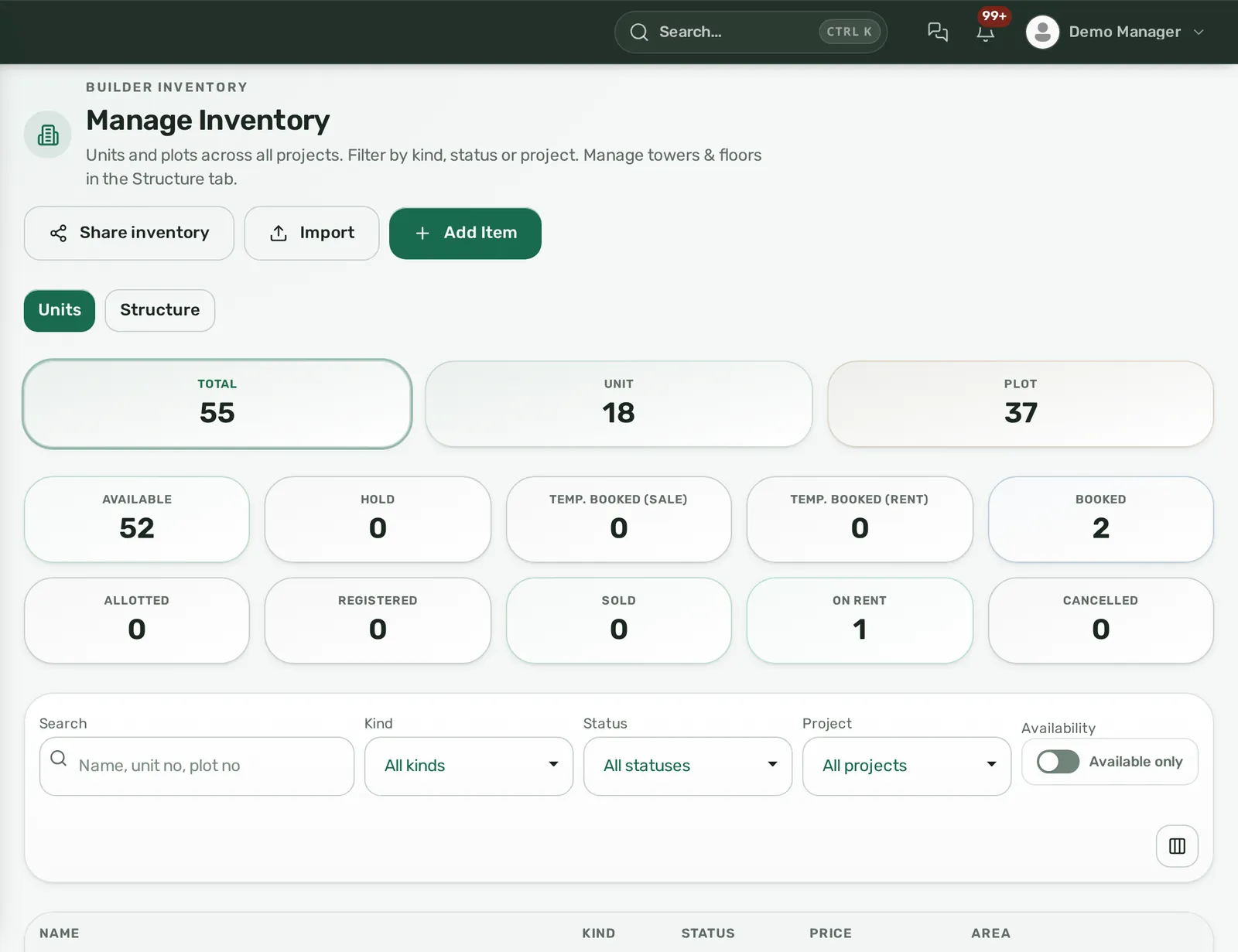
- Status path: Available → Hold → Temporary Booked (deposit received, SPA pending) → Booked → Sold. The system, not a WhatsApp group, must refuse a booking on a unit that is already Booked or Sold.
Illustrative example: a developer releases 120 units at 10:00. The sales head pre-allocates 40 to channel partners the evening before, with holds that lapse at 09:00 if no EOI deposit is matched. On launch morning, agents hold from the remaining 80; each hold lasts 45 minutes unless a booking deposit is recorded against it. By noon the inventory screen, not a spreadsheet, shows what is left, and the hold history settles every argument about who held unit 1204 first.
Give brokers live stock, not screenshots
Brokerages working a launch need the developer's current availability and a way to request a booking that the developer accepts or rejects. The alternative is brokers sending unit numbers over WhatsApp, a coordinator updating a sheet, and two buyers paying deposits on the same unit. The unit tracking guide covers the status model in more depth.
How do payment plans and demand letters work in an off-plan CRM?
Pick the plan structure first
Dubai off-plan plans come in three shapes, and a CRM should support all three as templates:
- Time-linked: fixed percentages on fixed dates (every quarter, for example).
- Construction-linked: percentages released when a construction milestone is certified (20%, 40%, 60%, 80% complete).
- Hybrid: a booking percentage, construction-linked lines in the middle and a handover percentage, sometimes with post-handover lines.
Templates by buyer category (investor versus end-user) save re-typing, and a custom schedule per booking handles negotiated deals.
Worked example (illustrative)
A two-bedroom unit at AED 1,400,000 on a 60/40 construction-linked plan:
| Line | Trigger | Share | Amount (AED) |
|---|---|---|---|
| Booking deposit | On booking | 10% | 140,000 |
| SPA signing | 30 days after booking | 10% | 140,000 |
| 20% construction | Milestone certified | 10% | 140,000 |
| 40% construction | Milestone certified | 10% | 140,000 |
| 60% construction | Milestone certified | 10% | 140,000 |
| 80% construction | Milestone certified | 10% | 140,000 |
| Handover | Completion | 40% | 560,000 |
When the site team marks 40% construction complete, the CRM should raise the 40% line on every booking in that project with a due date (15 days later is a common default), generate the demand letter from your own template, send it by email with a PDF and a WhatsApp notice, and start a reminder cadence if the line goes overdue.
Demand letters, reminders and late interest
- Send per line or in bulk from a list of recommended demands, always from a template your legal team has approved.
- Set a reminder cadence for overdue lines (every seven days is a sensible start), with an alert to the assigned agent so a human calls before the third reminder.
- Charge late payment interest only where the SPA provides for it. Keep it off by default and enable per project with the rate, grace period and basis written down.
- Trade-off: WhatsApp demand notices are read fast but need Meta-approved templates and a tone that suits buyers paying seven figures. A good pattern is the formal letter by email and the short reminders on WhatsApp.
Record collections against escrow
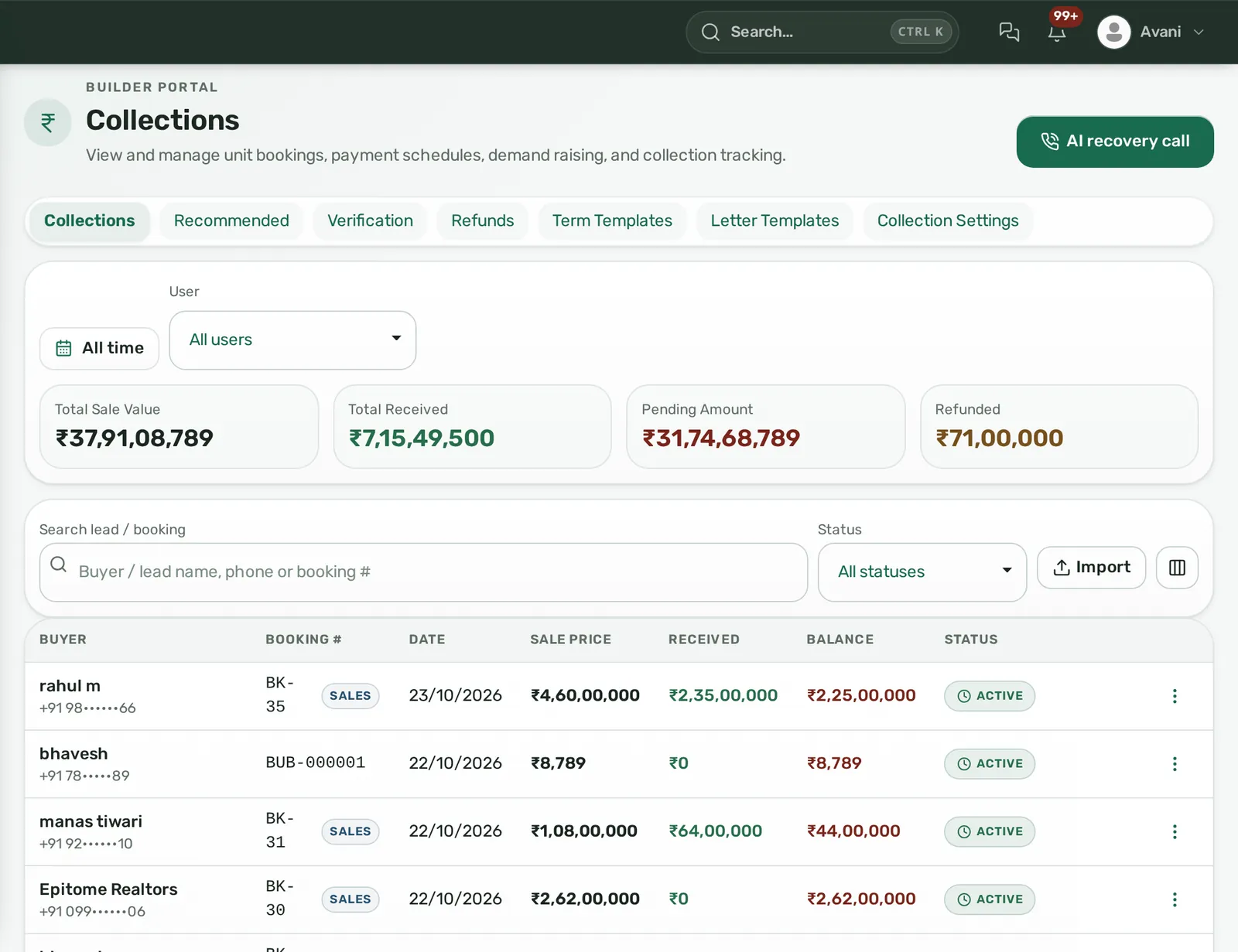
Off-plan payments are made into the project's DLD-registered escrow account. The CRM is not the bank, so the workflow is: receipt entered against the payment line with mode and reference (transfer, cheque, card), a finance verification step before it counts as received, cheque clearance and bounce handling with a charge if your SPA allows, and a buyer statement showing agreed, due, received and balance. Reconcile CRM receipts with the escrow statement weekly; monthly is too late to catch a mis-posted transfer. The wider workflow is covered in post-sales automation for real estate.
How should Oqood, DLD fees and the title deed appear in the CRM?
A dated, owned stage tracker on every booking
Oqood is the interim registration of an off-plan sale with DLD in the buyer's name; the title deed follows completion. Both are stages, not notes: SPA signed → KYC complete → DLD fee collected → Oqood registered → milestones → completion → final payment → title deed issued. Each stage needs a date and the user who ticked it, so you can report on bookings with an SPA but no Oqood after 30 days, or units handed over without a title deed step.
The fee breakdown
A booking should show the full cost to the buyer and the developer: the DLD registration fee (commonly quoted as a percentage of the sale value plus administrative charges), any trustee or registration fees, agreed broker commission plus VAT, and who pays which line per the SPA. Use these as defaults and check the current fee schedule with DLD before quoting.
Registration happens outside the CRM
The submission to DLD is done through DLD's own channels by your registration team or the developer's. The CRM holds what matters afterwards: the date, the reference, the certificate as an attachment on the booking, and the fee receipt. Build a weekly report of bookings stuck between SPA signed and Oqood registered and give it an owner.
What AML/KYC and compliance checks belong on every off-plan booking?
UAE AML rules require real estate developers and brokers to perform customer due diligence and to report certain transactions; take advice from your compliance adviser on the specifics. The CRM's job is to make the checklist unavoidable. A practical per-booking list:
- Identity: passport and Emirates ID (residents) or passport and visa status (non-residents) for every applicant; corporate buyers add trade licence, memorandum and authorised signatory letter.
- Source-of-funds declaration where your policy requires it; PEP and sanctions screening outcome recorded.
- Payment method checks, especially large cash amounts, against your reporting obligations.
- Broker details: RERA broker registration number and card validity when a brokerage is involved, and the standard RERA forms filed.
- Deal documents: signed booking form, SPA, DLD fee receipt, Oqood certificate, later the title deed.
- Marketing consent captured for WhatsApp and email.
Store each item as a document on the booking with a tick in the checklist, restrict who can open identity documents, and keep an audit trail of who changed what. The security page explains how tenant isolation, role scopes and audit logs work in a CRM.
What do brokers and channel partners need from a developer's off-plan CRM?
Most Dubai launches are sold through a mix of direct sales and channel partners, and commission disputes are the biggest avoidable headache.
- A partner master with the agreed commission percentage and the projects each partner may sell.
- Lead registration with a partner reference and timestamp, so 'who brought this buyer' has one answer.
- Commission as separate legs (developer side, buyer side, reference), each payable on its own schedule and voided automatically when a booking is cancelled.
- Payout timing tied to collection milestones, for example after the booking and SPA lines are received, so you never pay out on money you have not collected.
- A partner view of live inventory and the status of their booking requests.
The channel partner management guide goes through onboarding and payouts in detail.
How does Homelead run off-plan sales for Dubai developers and brokers?
Homelead's Builder panel models a project as towers, floors and units (or plots), each with a status of Available, Hold, Temporary Booked, Booked, Allotted or Sold. Holds and releases keep a history, and a booking on a unit that is already Sold or Allotted is refused, so launch-day double booking is blocked by the system. Brokers request access to a developer's stock through Shared Inventory, see live status once approved and send booking requests; an accepted request becomes a sale that appears on both sides.
Payment plans can be construction-linked, time-linked or hybrid, built from payment-term templates (percentage or fixed lines with due offsets, by customer category) or set per booking. With CLP auto mode, completing a construction phase raises the due lines, and demand letters go out per line or in bulk from Recommended demands by email and WhatsApp with a shareable link, using your own template. Overdue lines get automatic reminders every N days, late interest and cheque-bounce charges are configurable, and every buyer has a statement PDF with agreed, due, received and balance.
Every booking carries a deal file: a stage tracker with UAE stages including Oqood, DLD and Title Deed (each time-stamped with the user), a fee breakdown with DLD percentage defaults, a compliance checklist covering AML/KYC, RERA forms and Ejari, and loan records. Cancellations apply a configurable charge, track the refund to settlement and void due commissions. Channel partners sit in a master with commission percentage and project allocation, and commission is tracked per leg in Finance. UAE accounts are invoiced in AED, the panel works in English and Arabic, tax invoices follow the bilingual FTA format, listings push to Property Finder and feed Bayut and dubizzle, and every project gets a microsite with a QR code for hoardings. Region details are on the markets page, and you can book a demo on your own inventory sheet.
Which mistakes cost off-plan teams the most?
- Treating EOIs as bookings, then spending weeks unwinding refunds.
- Holds with no expiry, so launch inventory looks sold out while half the holds are dead.
- Running the payment plan in Excel and the CRM in parallel; they drift within a month.
- Recording Oqood as a note, so nobody can report on unregistered sales.
- Paying partner commission before the SPA line is collected, with no link to cancellation.
- Collecting KYC on WhatsApp and never attaching it to the booking.
Frequently asked questions
Should an EOI be a lead or a booking in the CRM?
A lead. Record it as a lead stage with the deposit as a payment record and receipt, plus the buyer's unit preference and partner reference. Convert to a booking only when a unit is allocated and the booking deposit is paid; otherwise booked counts and refund reports become meaningless.
How do we stop two agents booking the same unit on launch day?
Use a unit status model (Available, Hold, Temporary Booked, Booked, Sold) that the system enforces, with hold expiry, a cap on holds per person and a logged release reason. The CRM must refuse a booking on a unit that is already Booked or Sold; a WhatsApp group cannot.
What is Oqood and where should it sit in the CRM?
Oqood is the Dubai Land Department's interim registration of an off-plan sale in the buyer's name, issued before the title deed. Keep it as a dated stage on the booking with the user who completed it, the reference and the certificate attached, so you can report on sales that are still unregistered.
How should construction-linked payment plans trigger demand letters?
Define the plan as template lines tied to milestones. When the project marks a milestone complete, the CRM raises that line on every booking with a due date, generates the letter from your template, sends it by email and WhatsApp, and starts overdue reminders at a set interval.
What AML/KYC documents belong on an off-plan booking?
Identity documents for each applicant (passport, Emirates ID or visa status), corporate documents for company buyers, a source-of-funds declaration where your policy requires it, the screening outcome, the signed booking form and SPA, the DLD fee receipt and the Oqood certificate. Confirm current obligations with your compliance adviser and DLD.
Can brokers and developers work in the same off-plan CRM?
Yes, if the CRM supports shared inventory with developer approval and a booking-request flow. The broker sees live unit status and sends a request; the developer accepts it, the sale appears on both sides, and partner commission is tracked per deal.