
Broker commission management software replaces the month-end spreadsheet with one commission record per deal: the formula, who owes it, who is owed, and what has actually been paid. The model that holds up in practice has three parts: a formula (percentage of deal value, a fixed amount, or days of rent), separate legs for the owner side, the buyer side and any reference, and a status on each leg so a cancelled booking voids what was due instead of leaving it quietly in a column.
Key takeaways
- Three formulas cover almost every brokerage deal in India and the UAE: percentage of deal, fixed amount, and days or months of rent.
- Split every deal into legs: owner (seller or landlord), buyer (or tenant) and reference (referrer, co-broker or channel partner). Each leg is either receivable or payable and is settled on its own.
- Receivable and payable are separate ledger rows with statuses, never one "commission" number.
- Agents see their own legs, managers their reporting line, finance everything.
- Cancellation voids due legs automatically and flags paid legs for clawback.
- Month-end is a checklist against bookings, not a rebuild of the sheet.
Why do commission spreadsheets break at month-end?
A commission sheet starts as one row per deal with columns for value, rate and amount. It works for the first thirty deals and then fails for predictable reasons:
- The formula lives in a cell. Someone overwrites it with a hard-coded figure for a "special case", drags it down, and the special case becomes the formula for every deal below.
- Legs collapse into one column. A deal that earns 1% from the seller, 1% from the buyer and owes 20% of one side to a referrer becomes a single figure. When the referrer asks what they are owed, the maths is rebuilt from memory.
- Nothing links the sheet to the booking. A booking cancelled in February still shows a paid commission in March because the person handling the cancellation does not own the sheet.
- Visibility is all or nothing. Either the whole team sees everyone's earnings or nobody sees anything and agents message accounts every week.
- There is no history. When a figure changes, nobody can see what it was before or who changed it.
Software fixes this only if its commission model is built around formulas, legs and statuses. A CRM with one "commission amount" box per deal is a spreadsheet with a login.
Which commission formulas does a brokerage actually need?
Three formulas cover nearly every deal a brokerage in India or the UAE does. Use one per leg and never a free-text amount.
Percentage of deal value
The standard sale commission. In India, resale brokerage is usually negotiated as a percentage from each side; in Dubai, a percentage of the sale price from the buyer is the normal arrangement on secondary sales, and developers pay channel partners a percentage on off-plan units. Define the base clearly: the agreed price on the booking, not the list price and not the amount collected so far.
Fixed amount
A flat fee agreed up front: a referral fee, a finder's fee on a plot, or a fixed sum agreed with a developer for a launch. It does not move with price, so a renegotiation after booking leaves it unchanged.
Days or months of rent
Leasing commissions are quoted in rent time rather than percentages: fifteen days of rent from each side in many Indian cities, one month on a longer lease, or a percentage of annual rent in Dubai. Storing "15 days" as the formula means a rent revision at renewal recomputes correctly instead of someone recalling the old number.
| Formula | Typical use | Base | Watch out for |
|---|---|---|---|
| Percentage of deal | Sales, resale, off-plan | Agreed price on the booking | Base changes if price is renegotiated |
| Fixed | Referral and finder's fees, flat developer deals | None | Must still be tied to a booking so it can be voided |
| Days / months of rent | Leasing | Monthly rent on the lease | Renewal at a new rent needs a new leg |
If you run leasing alongside sales, the leasing CRM guide for Dubai brokerages covers how the lease record should feed rent-based commission.
What are the legs of a commission on a single deal?
A deal is not one commission; it is a small set of obligations pointing in different directions. Treat each as a leg with its own formula, counterparty, amount and status.
Owner leg
What the seller or landlord pays you for bringing the buyer or tenant. Receivable to the brokerage. Common on Indian resale and leasing; often zero on a Dubai secondary sale where the seller has their own broker.
Buyer leg
What the buyer or tenant pays you. Receivable. This is the main leg on most Dubai sales and on Indian leasing deals.
Reference leg
What you owe a third party for the lead: a referrer who passed the number, a co-broker on the other side, or a channel partner when you are the developer. Payable from the brokerage. Capture the reference person and the agreed reference commission at lead stage, because by booking time nobody remembers who sent the lead. Developers paying partners should read the channel partner management guide for the onboarding and allocation side.
Receivable versus payable
Receivable legs are money coming in and sit next to your invoices. Payable legs are money going out and sit next to your expenses. Net brokerage is receivable minus payable, and your internal agent payout policy should be applied to that net figure, not to the deal legs. Keep the agent split out of the deal record: it is an incentive matter computed on net, and mixing it into deal legs is how agents end up seeing each other's earnings.
Worked example 1: Indian resale (illustrative)
A 3 BHK resale in Pune, agreed price ₹1.2 crore.
| Leg | Formula | Direction | Amount |
|---|---|---|---|
| Owner | 1% of deal | Receivable | ₹1,20,000 |
| Buyer | 1% of deal | Receivable | ₹1,20,000 |
| Reference | 20% of buyer leg | Payable | ₹24,000 |
Gross receivable ₹2,40,000, payable ₹24,000, net brokerage ₹2,16,000. A GST-registered brokerage charges GST on top of each receivable invoice, and the referrer's payment may attract TDS under section 194H; confirm current rates with your accountant or at the Income Tax Department.
Worked example 2: Dubai secondary sale (illustrative)
An apartment in JVC sold at AED 2,000,000. You represent the buyer, another brokerage represents the seller, and a 50:50 co-broking split is agreed.
| Leg | Formula | Direction | Amount |
|---|---|---|---|
| Buyer | 2% of deal | Receivable | AED 40,000 plus VAT at the standard rate |
| Owner | None | — | AED 0 |
| Reference (co-broker) | 50% of buyer leg | Payable | AED 20,000 |
Net brokerage AED 20,000 before internal payout. VAT on brokerage services follows the Federal Tax Authority's rules at tax.gov.ae, and the broker's registration details should sit on the deal file as the Dubai Land Department requires.
Worked example 3: lease (illustrative)
A Jaipur flat let at ₹25,000 per month with 15 days of rent from each side: tenant leg ₹12,500 receivable, owner leg ₹12,500 receivable. At renewal with rent revised to ₹27,500, a fresh pair of legs recomputes to ₹13,750 each because the formula is stored, not the number.
How should receivable and payable move through statuses?
Every leg needs a status, and the permitted moves should be fixed so money cannot be undone silently.
- Due: the booking is confirmed and the formula has produced an amount.
- Paid: money moved, with date, mode and reference. A receivable leg can be paid in parts; store each part as its own receipt against the leg.
- Cancelled: voided before any money moved, with a reason.
- Failed: a bounced cheque or failed transfer; the leg stays due.
- Refunded: reachable only from Paid, with reason and amount.
The rule that matters: nothing goes from Paid back to Due by editing a cell. A paid leg that was wrong becomes a refund plus a new leg, and both rows stay visible. That is also what an auditor wants: a trail, not a corrected total. Tax belongs on the leg too; store the tax amount and whether tax is included in or added to the formula result, so the invoice view and the net figure agree.
Who should be able to see commission figures?
Scope visibility is the difference between a commission system agents trust and one they route around.
| Role | Should see | Should not see |
|---|---|---|
| Agent | Legs on their own bookings, status, what was paid and when | Other agents' deals, company-level payables |
| Team lead or branch manager | All legs in their reporting line, summaries by agent | Other branches |
| Finance or owner | Everything, including payables, refunds and change history | — |
Tie visibility to the reporting line rather than a separate commission permission list, so that moving a user to another team moves their visibility with them. Any change to a leg (amount, status, payee) should be logged with before and after values and the user who made it. The agent performance and commission tracking guide goes deeper on the manager's view.
What happens to commission when a booking is cancelled?
Cancellation is where spreadsheets lose the most money, because commission is often paid out before the deal has actually closed.
- Void every due leg automatically. When the booking is cancelled, legs still at Due move to Cancelled with the cancellation reason attached. Nobody should need to remember this.
- Flag every paid leg. A reference leg already paid becomes a clawback conversation; a receivable already collected may need a refund net of a deduction. The system should surface these, not hide them.
- Record the cancellation itself. Reason, refund amount to the customer, deduction or cancellation charge, and supporting documents.
- Keep the history. The cancelled booking and its voided legs stay in the ledger so quarter-end still reconciles.
Add a one-line timing policy: pay reference and partner legs only after the linked receivable is collected, or after the agreement is registered. This single rule removes most clawbacks.
How do you reconcile commissions at month-end?
With formulas, legs and statuses in place, month-end becomes a checklist.
- List every booking confirmed in the month; confirm each has its legs created and the formula base matches the agreed price.
- Receivable legs still at Due: chase, and check whether the booking has stalled.
- Payable legs at Due: release only where the linked receivable is Paid, per your policy.
- Cancellations in the month: confirm due legs were voided and paid legs flagged.
- Partial payments: confirm the sum of receipts equals the amount marked paid.
- Refunds: each has a reason and a matching outgoing entry.
- Export the commission statement and the change history for the accountant.
- Compare commission received with revenue booked; a widening gap is usually uncollected buyer legs, not a sales problem.
How Homelead handles broker commissions
Homelead uses one commission formula everywhere: Percentage of deal, Fixed, or Days/Month of rent, applied to sales and leases alike. Each booking carries three legs, owner, lead (the buyer or tenant) and reference, and each leg is payable separately. The reference name, phone and reference commission are fields on the lead itself, so a referral is captured when the lead arrives rather than reconstructed at booking.
The Finance → Commission tab shows agreed versus paid for every deal, lets finance mark a leg as paid or record a refund, and gives a summary split into receivable and payable. Commission due and received also appear on the dashboard. Visibility follows the user's scope: an agent sees their own, a manager their reporting line, an admin all of it.
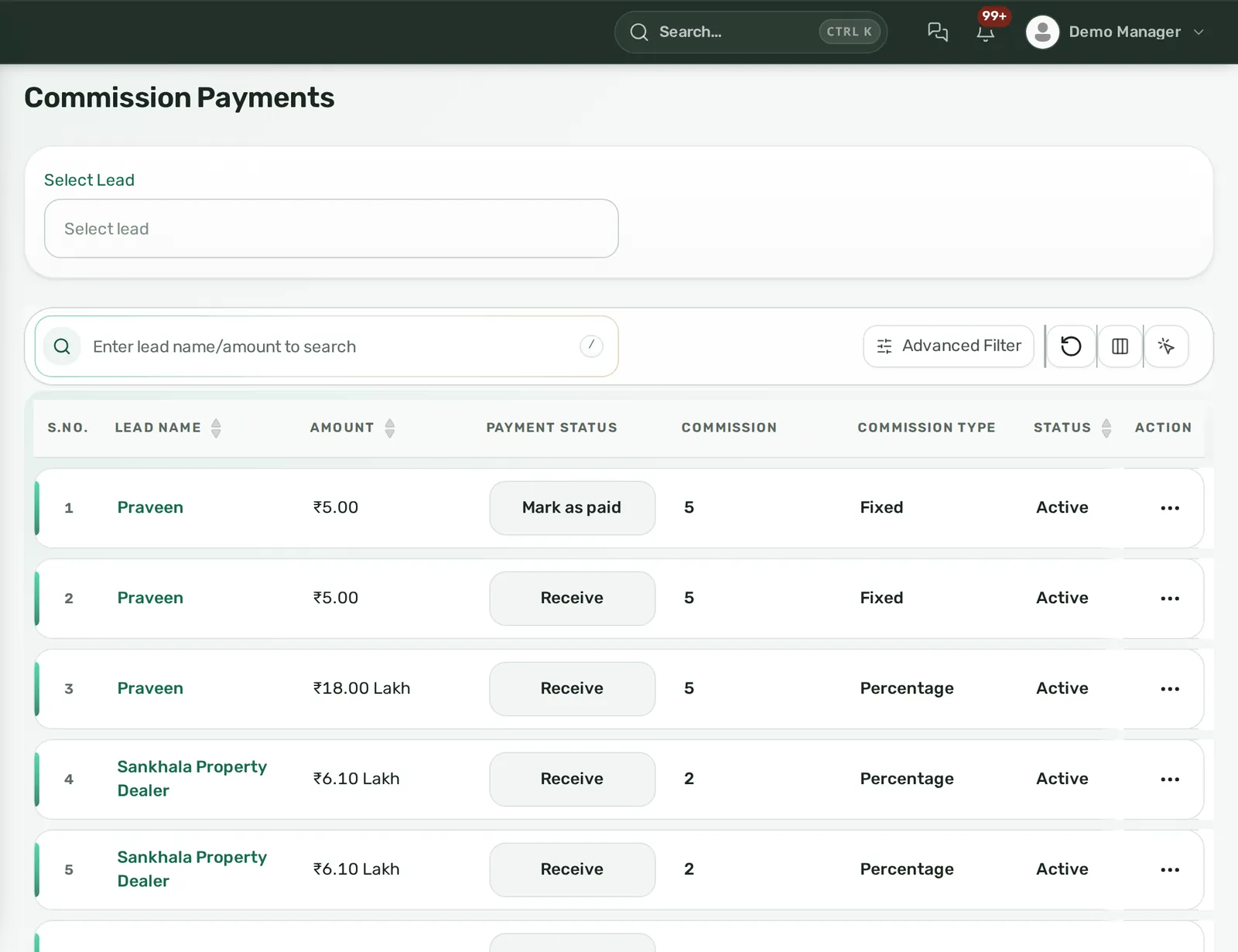
Commission entries sit in the same ledger as the rest of the company's money, with the status graph Due → Paid / Cancelled / Failed and Paid → Refunded, so a payment cannot be undone by editing. Delete is an archive with restore, and the Audit Logs screen records who changed a commission payment with before and after values (see security). When a broker records a Cancel & Refund on a booking, with reason, refund amount, deduction and attachments, the due commissions on that booking are voided. Statements export to CSV and PDF, and the ledger filters by payee, lead, broker, project, branch and date.
For builders, the Channel Partners master stores each partner's commission percentage and project allocation, and commission payments track the legs per deal. Broker management, commissions and payouts are included in every plan; see Homelead pricing. To see the Commission tab working on your own bookings, book a 20-minute online demo on your own data, or message +91 72400 44472 on WhatsApp.
Frequently asked questions
What is broker commission management software?
It is the part of a real-estate CRM or finance tool that stores a commission formula per deal, splits it into receivable and payable legs (owner, buyer, reference), tracks each leg's status from due to paid or refunded, and voids due legs when a booking is cancelled, so commissions are computed from bookings rather than rebuilt in a spreadsheet.
Should agent splits be stored on the deal?
No. Store the deal legs (what the brokerage receives and pays) on the booking and compute the agent's share separately from net brokerage under your incentive policy. Mixing agent splits into deal legs exposes one agent's earnings to another and makes clawbacks messy.
How do you handle GST or VAT on commission?
Record the tax amount on each leg and state whether the formula result is inclusive or exclusive of tax. In India a registered brokerage charges GST on its commission invoices and commission paid to referrers may attract TDS under section 194H; in the UAE brokerage services are subject to VAT under FTA rules. Confirm current rates with your accountant.
What should happen to a referral fee when the booking is cancelled?
If the fee is still due, it should be voided automatically with the cancellation reason. If it was already paid, the system should flag it for clawback or a refund entry. A policy of paying referral and partner legs only after the receivable is collected avoids most of these cases.
Can a brokerage doing both sales and leasing use one commission model?
Yes, provided the formula set includes days or months of rent alongside percentage and fixed. The legs stay the same: owner (landlord), buyer (tenant) and reference, and the lease's monthly rent is the base for rent-time formulas.
How often should commissions be reconciled?
Monthly against confirmed bookings, with a weekly glance at receivable legs still at Due and at cancellations. Monthly reconciliation keeps partner payouts and agent incentives tied to money actually collected.